
If You Can’t Tell Me Yesterday’s Sales, You Have a Record-Keeping Problem
If someone asked you right now, “How much did your business sell yesterday?”, could you give them the exact figure?
Not an estimate.
Not, “I think it was around ₦80,000.”
The actual number.
Now imagine they ask:
- How many products did you sell?
- How much came through transfer?
- How much was cash?
- Which product sold the most?
- Who is yet to pay?
- How much did you spend?
Could you answer those questions?
For many Nigerian SME owners, the answer is no.
The problem isn’t necessarily that the business isn’t making sales. The problem is that the business owner isn’t recording those sales properly.
A simple daily sales record can tell you where your money is coming from, which products are moving, what customers still owe you, and whether your business is actually improving.
And you don’t need complicated accounting knowledge to start.
What Is a Daily Sales Record?
A daily sales record is a simple record of the sales your business makes each day.
You can keep it in:
- A notebook
- Excel or Google Sheets
- A sales tracking app
- Business management software
At the most basic level, your daily sales record format should include:
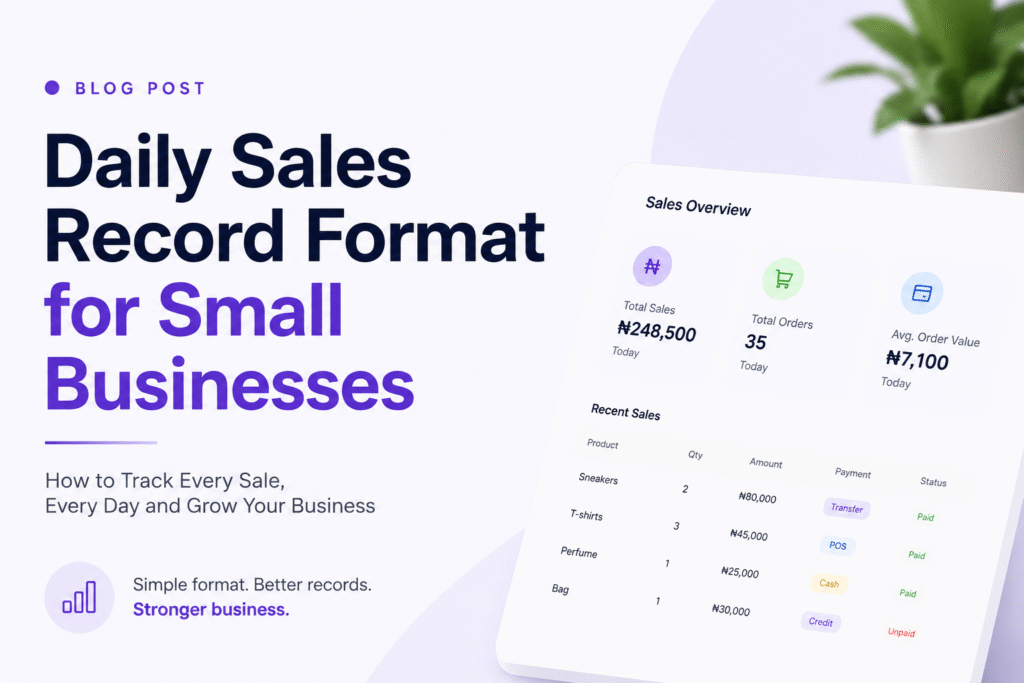
| Date | Product/Service | Quantity | Amount | Payment Method | Status |
|---|---|---|---|---|---|
| Aug. 14 | Sneakers | 2 | ₦80,000 | Transfer | Paid |
| Aug. 14 | T-shirts | 3 | ₦45,000 | POS | Paid |
| Aug. 14 | Perfume | 1 | ₦25,000 | Cash | Paid |
| Aug. 14 | Bag | 1 | ₦30,000 | Credit | Unpaid |
You can add other information depending on your business, such as customer name, cost price, delivery fee, discount, or profit.
The most important thing is consistency.
Record every sale. Every day.
Why Should Small Businesses Keep Daily Sales Records?
It’s easy to think:
“I’m a small business. I don’t need all this accounting wahala.”
But ignoring your numbers doesn’t make your business easier to manage.
It makes it harder.
A proper daily sales record helps you answer important questions before they become expensive problems.
1. You Know Exactly How Much You Sold
Your bank balance doesn’t tell the full story.
You may have received ₦200,000 today, but that doesn’t necessarily mean you made ₦200,000 in sales.
Some of the money could be:
- Customer deposits
- Payments for previous orders
- Personal transfers
- Money owed to suppliers
A sales record gives you a clearer picture of your actual business activity.
2. You Can See Your Best-Selling Products
Imagine you sell:
- Perfumes
- Body sprays
- Body creams
- Hair products
You may assume perfume is your biggest seller.
But your records might show that body creams actually generate more sales.
That information can influence what you restock, promote, and advertise.
Your sales data should influence your business decisions—not assumptions.
3. You Can Spot Missing Money
This is one of the biggest reasons to keep proper records.
Let’s say your business should have made ₦150,000 today, but only ₦125,000 is accounted for.
Without a sales record, you may never notice.
With one, you can investigate:
- Was there a discount?
- Was an order cancelled?
- Is someone yet to pay?
- Was a transaction recorded incorrectly?
Good records make problems easier to find.
4. You Can Track Different Payment Methods
Nigerian businesses receive payments in different ways.
Your customers may pay through:
- Bank transfer
- POS
- Cash
- Payment links
- Other digital payment methods
Recording the payment method makes it easier to reconcile your sales with actual transactions.
This becomes even more important as your business grows.
What Should Be Included in a Daily Sales Record?
Your daily sales book format doesn’t need to be complicated.
Start with these fields.
Date
Record when the sale happened.
Product or Service
Write exactly what the customer purchased.
Quantity
How many units were sold?
Selling Price
How much did the customer pay?
Payment Method
Was it cash, transfer, POS, or another method?
Payment Status
Was the sale fully paid, partially paid, or unpaid?
Customer Details
For businesses that rely on repeat customers, recording the customer’s name or contact can be useful.
Cost Price
If you’re selling physical products, recording your cost price helps you understand your actual profit.
Daily Sales Record Example for a Nigerian SME
Let’s say you run a small fashion business.
Your sales for Monday might look like this:
| Product | Quantity | Sales | Cost | Payment |
|---|---|---|---|---|
| Shirt | 3 | ₦45,000 | ₦27,000 | Transfer |
| Trousers | 2 | ₦50,000 | ₦32,000 | POS |
| Sneakers | 1 | ₦65,000 | ₦42,000 | Cash |
Your total sales are ₦160,000.
But your gross profit isn’t ₦160,000.
Your product cost is ₦101,000.
So your gross profit before other expenses is ₦59,000.
This is why simply checking how much money entered your account isn’t enough.
You need proper records.
Daily Sales Record Book vs Excel vs Sales Tracking App
There are several ways to record sales.
Notebook
A notebook is cheap and easy to start with.
But it has limitations.
Pages can get lost. Calculations can be wrong. Finding an old transaction can take time.
Excel or Google Sheets
Spreadsheets give you more flexibility.
You can create formulas, sort sales, and build basic reports.
But you still have to enter and manage the information yourself.
Daily Sales Record App
A daily sales record app can make the process easier because your transactions are stored digitally and can be reviewed later.
For businesses handling many transactions, this can save time and reduce manual errors.
PearMonie allows businesses to record sales, capture payment information, and keep their sales history organized in one place.
How to Record Sales for a Small Business Every Day
You don’t need to spend an hour doing this.
Build it into your normal sales process.
Step 1: Record the Sale Immediately
Don’t tell yourself:
“I’ll record everything tonight.”
That’s how transactions get forgotten.
Record the sale when it happens.
Step 2: Record the Payment Method
Don’t just write ₦50,000.
Record whether it was:
- Cash
- POS
- Transfer
- Other payment method
Step 3: Issue a Receipt
Give the customer proof of payment.
A proper receipt also creates a record of the transaction for your business.
Step 4: Update Unpaid Sales
If you sell on credit, don’t treat the money as cash received.
Mark the transaction as unpaid or outstanding.
Step 5: Review Before Closing
At the end of the day, check:
Total sales → Payments received → Outstanding payments → Expenses
This simple five-minute habit can give you much better control over your business.
Common Daily Sales Record Mistakes
Even businesses that keep records can get them wrong.
Recording Sales at the End of the Week
Your memory is not a reliable accounting system.
Record sales daily.
Recording Only Large Transactions
₦2,000 here.
₦5,000 there.
Those small sales add up.
Record everything.
Mixing Personal and Business Transactions
If you’re using the same account for business and personal spending, your records can quickly become confusing.
Keep your business money separate where possible.
Not Recording Credit Sales
A customer promising to pay next week doesn’t mean you’ve received the money.
Record it as outstanding.
Not Reviewing the Numbers
Recording data without looking at it defeats the purpose.
Review your sales regularly to understand what’s working.
How Daily Sales Records Help You Calculate Profit
Sales records become even more valuable when you combine them with expense records.
For example:
Total sales: ₦500,000
Cost of products: ₦300,000
Other business expenses: ₦100,000
Your estimated net profit is:
₦500,000 − ₦300,000 − ₦100,000 = ₦100,000
Without accurate sales and expense records, you may think you’re making more—or less—money than you actually are.
This is why sales tracking and expense tracking should work together.
How PearMonie Makes Daily Sales Tracking Easier
If you’re tired of notebooks, scattered WhatsApp messages, and spreadsheets, PearMonie gives you a more structured way to manage your sales.
With PearMonie, you can:
- Record sales
- Track payment methods
- Keep your sales history organized
- Generate invoices
- Issue digital receipts
- Track expenses
- Manage customer information
- Review your business performance
Instead of having your sales records in one place and everything else somewhere else, PearMonie helps bring important parts of your business management together.
What About Business Funding?
There’s another reason good sales records matter.
Your records can show you when your business needs more working capital.
For example, you may discover that:
- Your best-selling product constantly goes out of stock
- Customer demand is increasing
- You need more working capital
- A particular product isn’t selling
- Your sales are growing month after month
Now you have actual information to guide your next decision.
If you’re considering financing to restock or expand, understanding your sales history can help you determine how much funding your business actually needs.
Eligible businesses can also explore PearMonie Business Loans to support business growth.
The goal isn’t to borrow simply because money is available.
The goal is to understand your numbers, identify a genuine opportunity, and use financing responsibly.
A Simple Daily Sales Checklist
Before you close your business for the day, ask:
- Did I record every sale?
- Did I record how each customer paid?
- Did I issue receipts?
- Did I update unpaid orders?
- Did I record today’s expenses?
- Do my records match the money received?
- What was my best-selling product today?
If you can answer these questions every day, you’re already building a stronger financial system.
Final Thoughts
You don’t need a complicated accounting system to start managing your business properly.
You need consistency.
Record every sale.
Track every payment.
Keep your receipts.
Review your numbers.
Then use what you learn to make better business decisions.
Your daily sales record may look like a small administrative task, but over time, it becomes one of the most valuable sources of information in your business.
If you’re still writing sales in a notebook or trying to remember transactions from WhatsApp chats, it may be time to simplify the process.
Start recording your sales with PearMonie and get a clearer view of your business.
And when your numbers show that it’s time to restock, expand, or take the next step, eligible businesses can explore PearMonie financing options with a better understanding of what their business actually needs.
Frequently Asked Questions
What is the best daily sales record format for a small business?
A simple format should include the date, product or service, quantity, selling price, payment method, and payment status. You can add customer details, cost price, and profit where necessary.
How do I record sales for a small business?
Record every transaction as it happens. Include what was sold, how much the customer paid, the payment method, and whether the transaction has been fully paid.
What is a daily sales book?
A daily sales book is a record of all sales made by a business each day. It can be a physical notebook, spreadsheet, or digital sales tracking system.
Is there a daily sales record app for small businesses?
Yes. Digital sales tracking apps help businesses record transactions and review their sales history without relying on paper records. PearMonie provides tools for recording sales and managing sales history.
Why should I record sales every day?
Daily records reduce forgotten transactions, help you monitor revenue, identify your best-selling products, track outstanding payments, and make better business decisions.
Can sales records help me calculate profit?
Yes. Sales records show your revenue. When combined with product costs and other business expenses, they help you calculate gross and net profit.
Can good sales records help when applying for business financing?
Accurate records help you understand your revenue, expenses, cash flow, and funding needs before borrowing. They also give you a clearer picture of how much your business can reasonably afford to finance.
What is better: a sales notebook or a sales tracking app?
A notebook can work for a very small number of transactions, but a sales tracking app is easier to search, review, and maintain as your business grows.